What is an AI agent runtime?
A framework gives you the agent loop. A runtime runs it in production: durable steps, checkpoints, approvals, crash recovery, and replaying one failed step.
- Runtime
- Ops
An AI agent framework helps you write the loop: call a model, choose a tool, decide what happens next. An AI agent runtime is what runs that loop in production. It owns the workers, the queue, the record of every step, and what happens when something breaks halfway through.
Most teams meet the second half late. The agent works on a laptop. Then a worker restarts mid-run, a refund needs a person to approve it, or step four returns nonsense and nobody can see what it was given. None of those are prompt problems. They are runtime problems.
What a runtime has to do
- Run steps durably. Work runs on queue-backed workers, and state is written to a database as it happens, not rebuilt from logs.
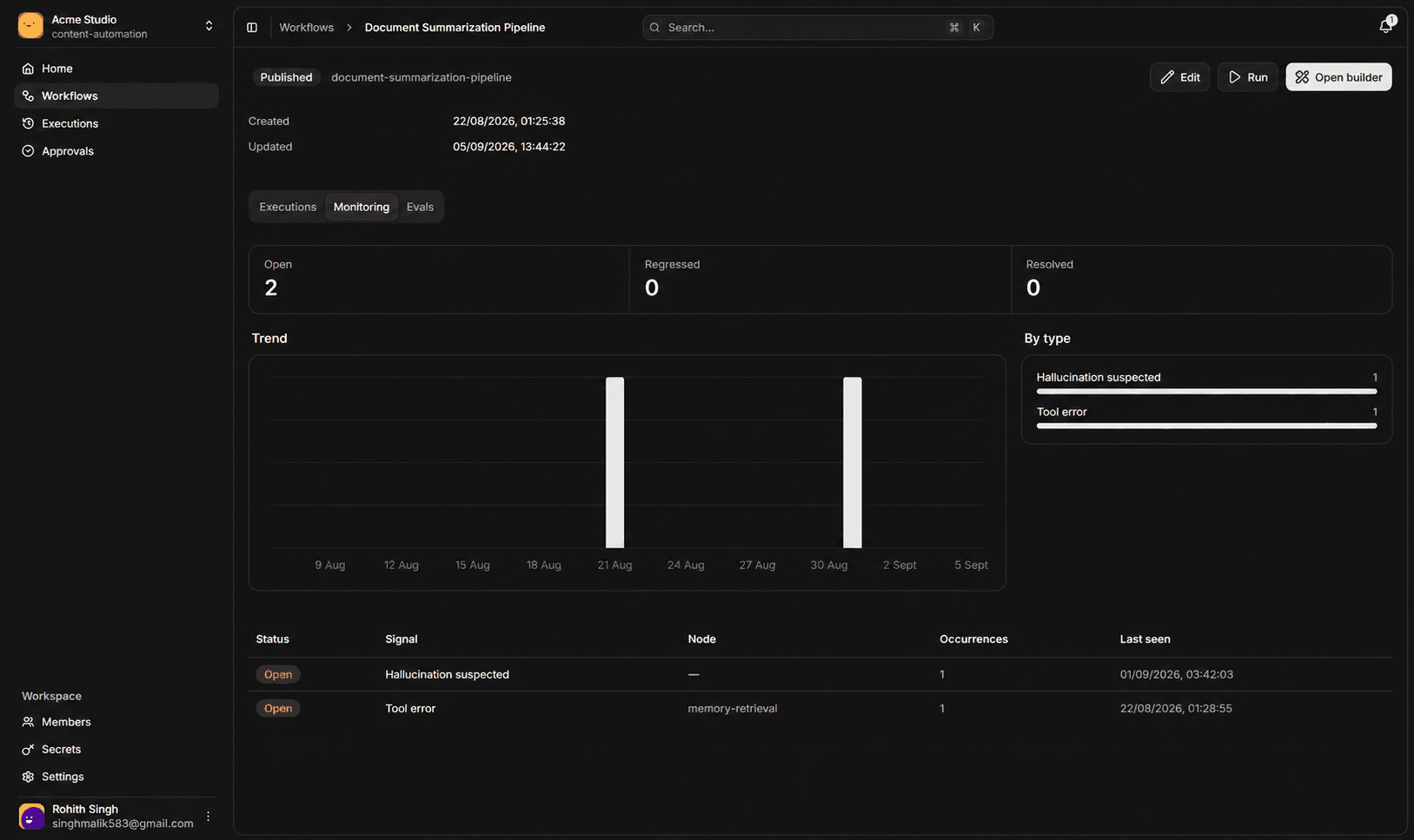
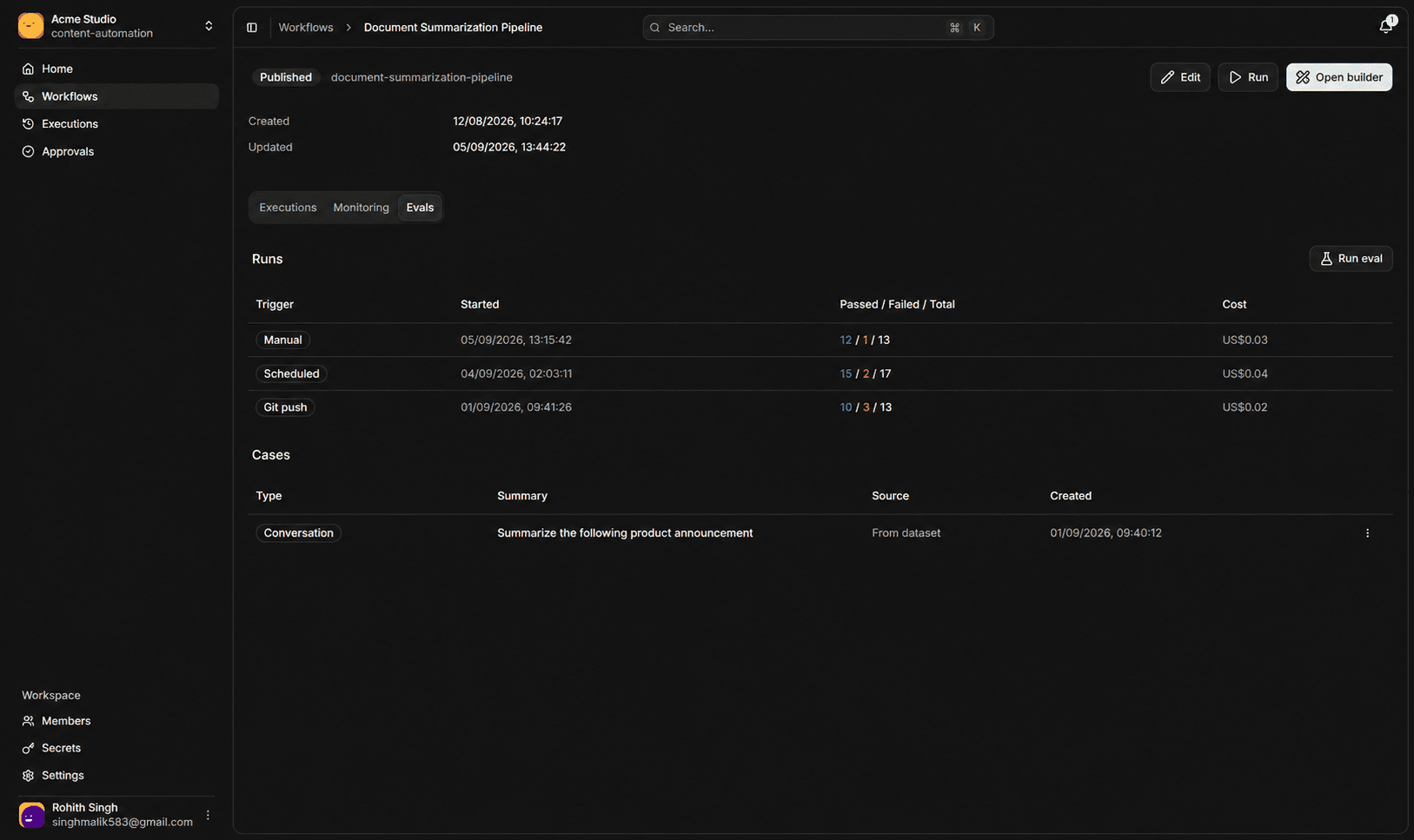
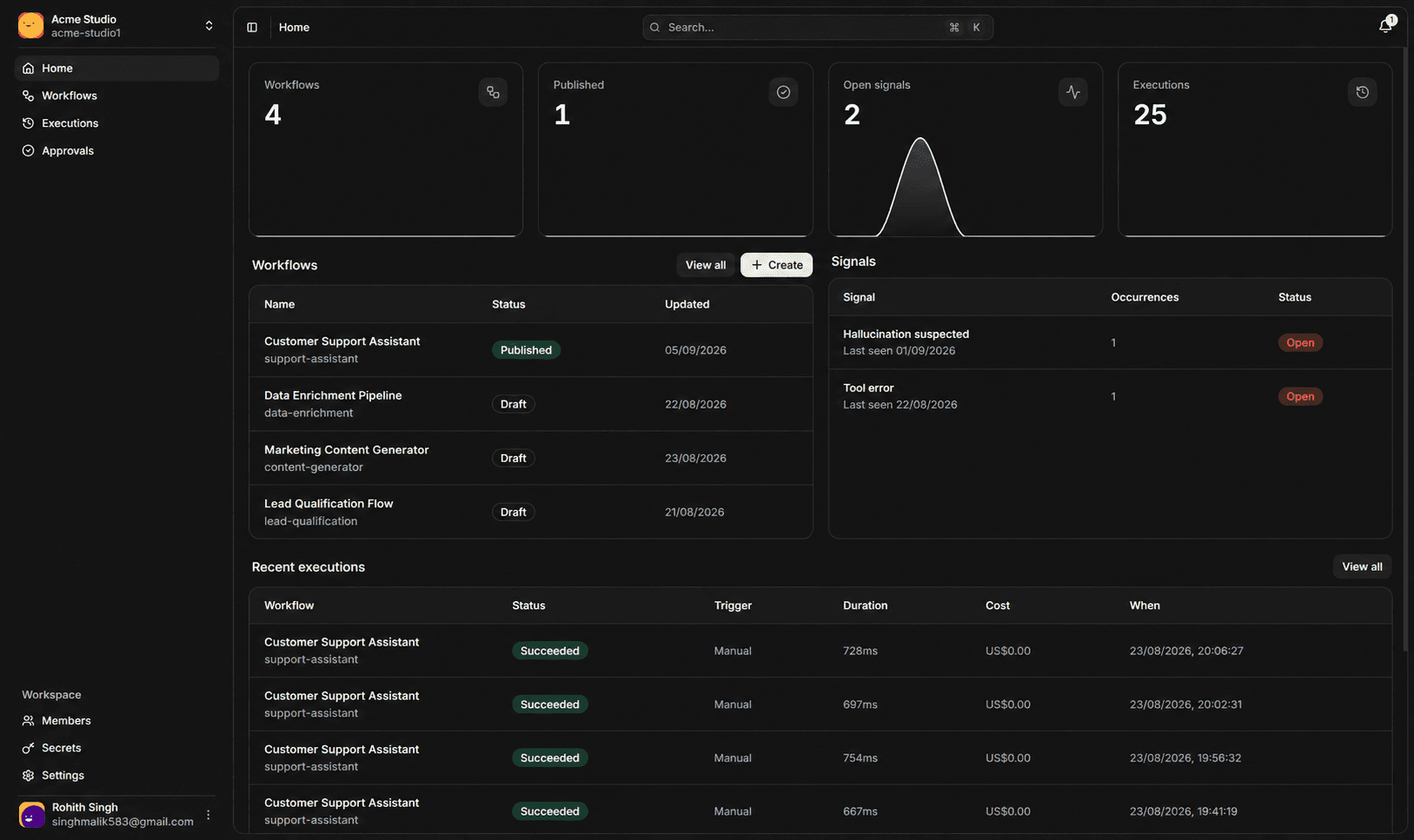
- Record every step. Each step's input, output, tokens, and cost are stored, and a checkpoint marks what has completed.
- Survive a crash. If a worker dies, another one picks the run up from the last checkpoint instead of starting over.
- Pause without losing state. Approvals and timed waits hold the run until a person decides or the timer fires, then continue from that step.
- Replay one step. When a node misbehaves, you run that node again against the exact input it received, without re-running the steps before it.
- Remember across runs. Facts one run learns are stored where a later run can read them.
- Govern side effects. Writes to outside systems wait for consent and leave an audit trail.
Framework, orchestration, runtime
The three terms get used interchangeably. They are different layers.
| Term | What it is | Who runs it |
|---|---|---|
| AI agent framework | A library for prompts, tools, and control flow | Your own process |
| Agent orchestration | The order of model calls, tools, approvals, and plain logic | Whatever executes the graph |
| AI agent runtime | Durable execution, checkpoints, waits, replay, and run history | A host built to keep the record |
A framework is code you import. Orchestration is a property of the graph. A runtime is infrastructure. You can ship a framework without a runtime, but then the runtime is whatever you build around it: the queue, the retries, the state tables, and the audit trail.
How Linea does it
Linea is an open-source runtime and control plane for production agents, written in TypeScript. You draw the workflow graph in the visual builder. Linea runs each published version on BullMQ workers with state in Postgres. Every step is recorded with its input, output, tokens, and cost. Workers hold a 30-second lease on a run, so if one crashes, another picks the run up from the last checkpoint.
Approval and wait nodes pause a run until someone decides or a timer fires. Step-level replay reruns one completed step against its original input, inside the same execution. A memory node stores key-value facts that later runs can read. Writes to Google and GitHub go through a connector gateway that waits for consent and keeps an audit record. Saved steps become regression cases that run again when you publish a new version.
You keep the prompts, tools, and business logic. Linea executes the graph and keeps the records. Linea is pre-1.0, so interfaces may still change. Read how the runtime works, or follow the getting-started guide.