Linea Labs vs n8n and Zapier: when you need an agent runtime
n8n and Zapier are great at connecting apps. Here is when an AI agent needs a runtime instead: checkpoints, step replay, and approvals tied to one exact action.
- Runtime
- Comparison
This post is about Linea Labs, the open-source AI agent runtime at getlinea.app. It is not the Consensys Linea network or the Linea sketching app. If you landed here for either of those, the disambiguation note will point you the right way.
If you are building an AI agent that does real work, n8n and Zapier are often the first tools you try. That makes sense. They connect to a lot of apps, you can get something running in an afternoon, and both now have agent features built in. So the fair question is not "which one is better." It is "what job am I hiring this tool for, and what happens on the day the agent fails halfway through?"
What n8n and Zapier do well
Both are workflow automation tools first. A trigger fires, steps run, data moves between apps. They have since added agents on top of that model.
n8n has an AI Agent node that can call tools. Its docs describe human review for tools: you can require approval before the agent runs a tool, for all of its tools or only selected ones, through channels such as n8n Chat, Slack, Gmail or Microsoft Teams. Approve and the tool runs with the input the model proposed. Deny and it does not run. n8n can also be self-hosted, which matters to teams that want the data on their own machines.
Zapier folded its standalone agents product into AI by Zapier, a step you drop into any Zap. Per Zapier, that step carries the same pieces as before, a prompt, tools, a trigger and permission to act, and now gets Zapier's triggers, filters, paths and run history. The "Require approval before running" setting applies per tool.
If your agent reads an email, summarizes it and posts a message, either of these is probably the right call. You get a big catalog of integrations and a visual editor, and with Zapier you do not need to run anything yourself.
What changes when the agent takes real actions
The harder cases show up when an agent runs for a while, touches systems that matter, and something goes wrong partway through. We ask five questions of any tool before we would trust it there.
If the worker dies mid-run, where does the run pick up: from the start, from the failed step, or not at all? Can you rerun one step against the exact input it saw, rather than the whole run or today's data? If a write to Gmail or GitHub times out, does the tool retry it blindly? A retry on an ambiguous failure is how the same email goes out twice. Is an approval tied to one exact action, or does "approved" let through whatever the agent does next? And if you edit the workflow while runs are paused, which version do they resume on?
Workflow tools answer some of these, and the answers change between releases, so check their current docs against your own case. Linea was built around these questions from the start, which is the main difference in focus.
How the Linea Labs agent runtime handles them
Linea is a host for agents and workflows. You draw or define a graph, publish a version, and start an execution by hand, from a webhook, on a schedule, or from the TypeScript SDK. The host runs every step and keeps the record. Here is what that record buys you.
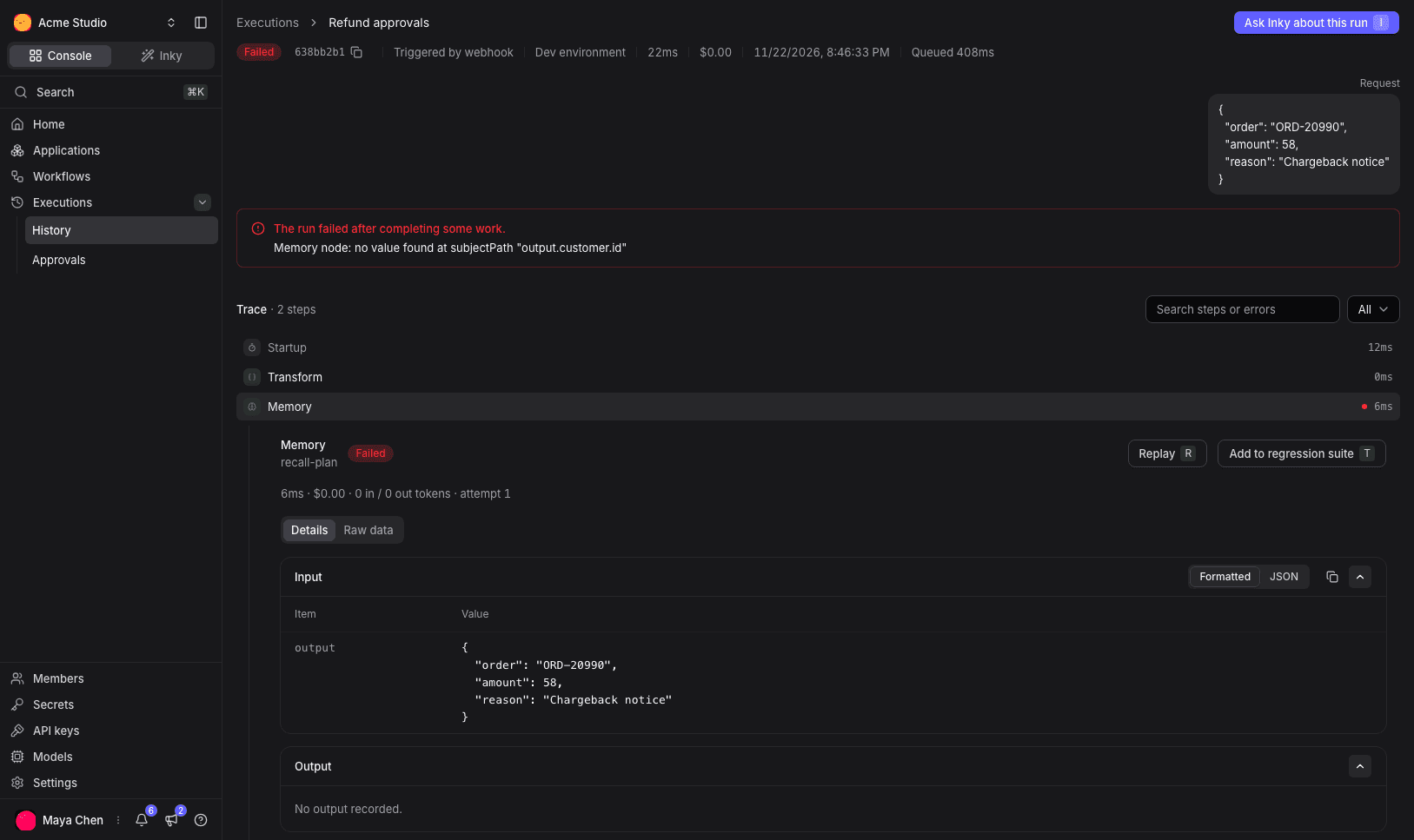
Checkpoint after every step. Each completed node writes a checkpoint: the ids of completed steps, their outputs, and any workflow variables. If a worker loses its lease mid-step, that step gets no successful checkpoint, and the run resumes from the last node that finished. More on this in what happens when a worker dies and on the runtime page.
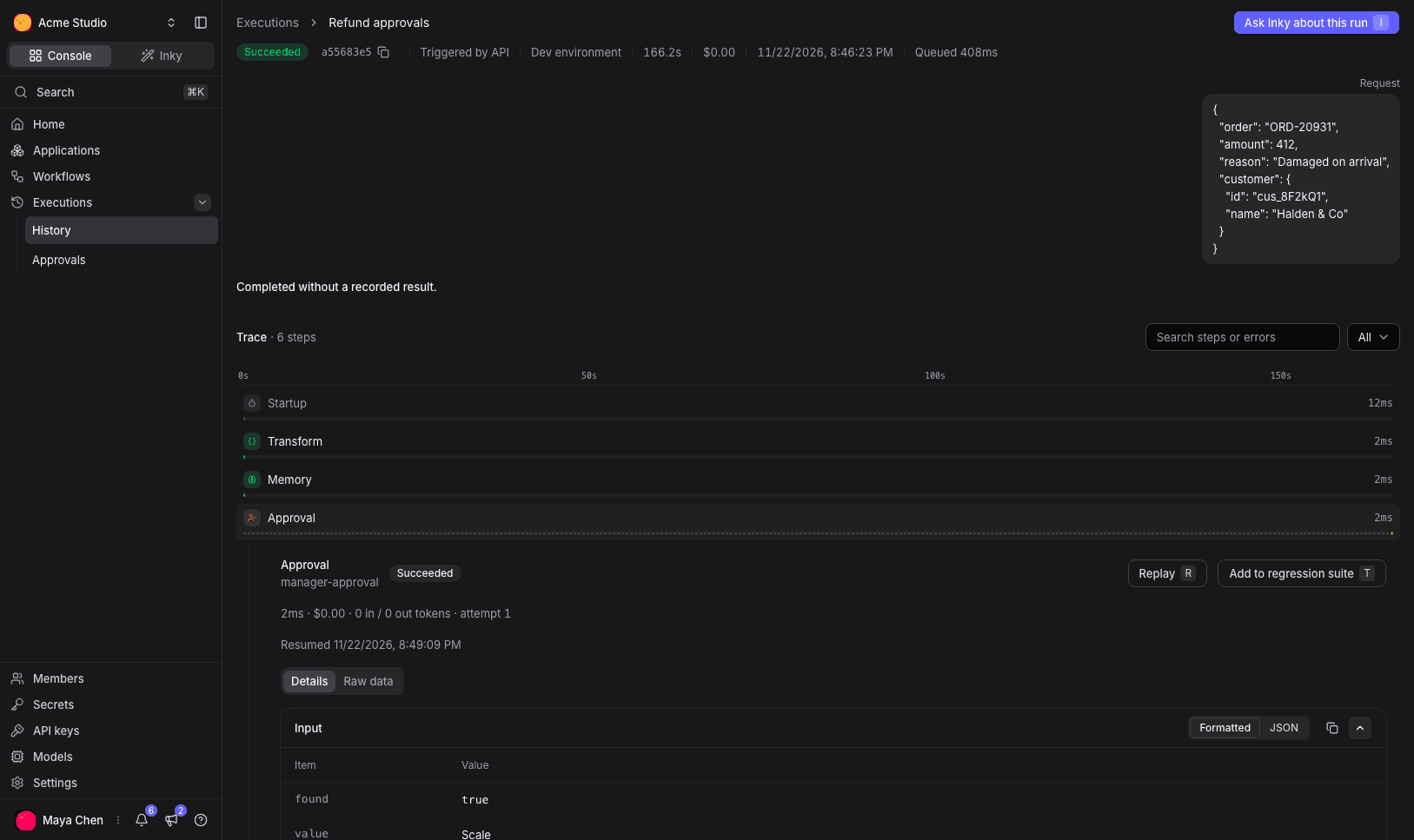
Step replay. Because the host ran every step, it stored each step's input and output. You can rerun one node against the input it originally saw, change the prompt or model, and freeze the fix as a regression case. That only works if the host kept the checkpoint, which is the point of why replay needs the checkpoint. See the replay page. Replay refuses steps that could change the outside world, such as connector calls and approvals, so testing a fix cannot fire a real action.
Side effects go through one gateway. Every connector call that changes something becomes an Action Intent with an idempotency key and a canonical digest of the action. Reusing a key for a different action fails with idempotency_conflict. If a write fails in an ambiguous way, such as a network error after the request may have reached the provider, the outcome is recorded as outcome_unknown. Whether Linea retries depends on the operation. Gmail send, GitHub issue and pull request creation, and Calendar update are dispatched once. Only an operation the provider can deduplicate, such as Calendar create, is retried, and then at most once. Side effects from an agent run are never retried automatically.
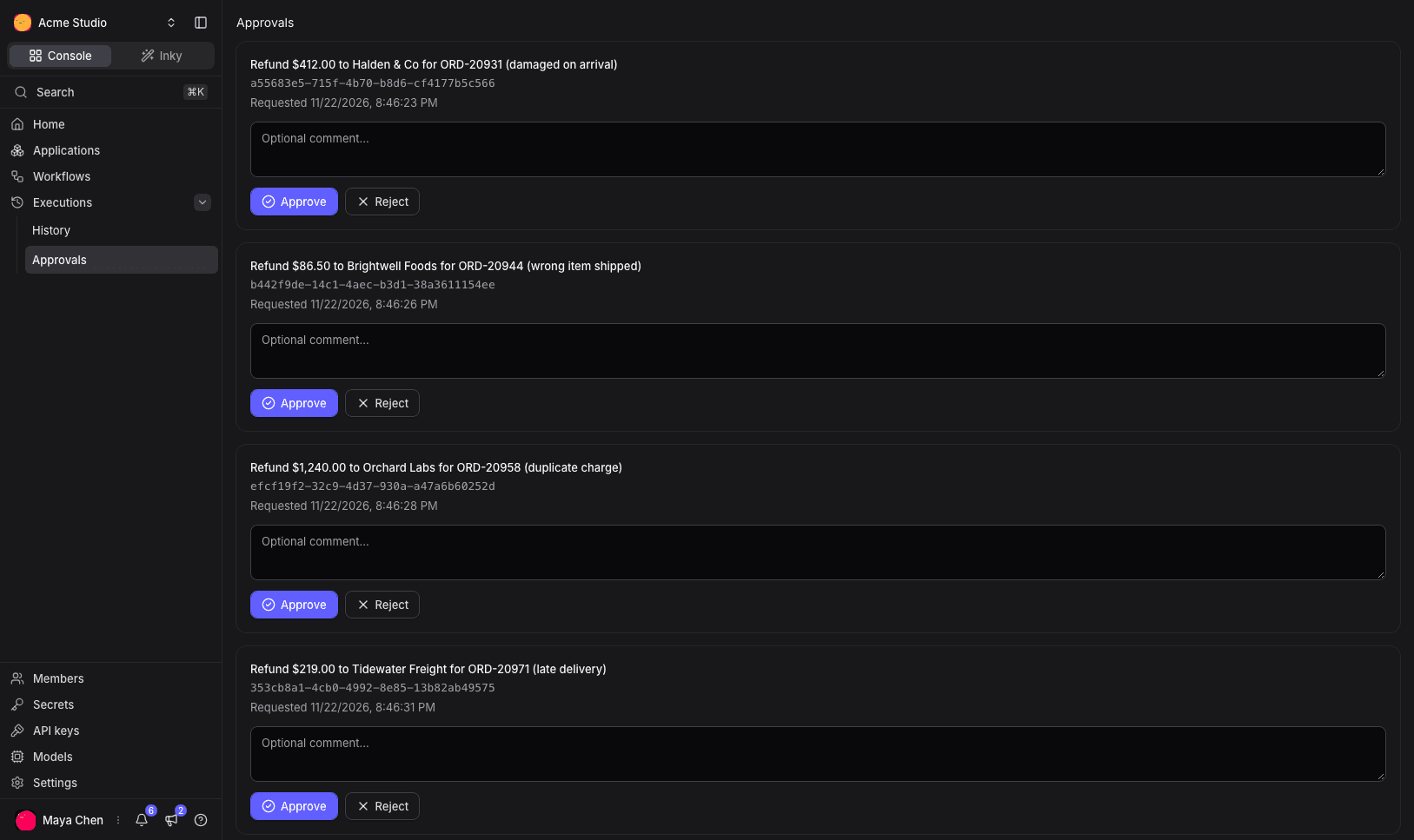
Approvals bound to one action. When consent is required, the run pauses on an approval request. The consent covers the exact Action Intent, so approving one action does not release another. A paused run releases its lease and holds no worker while it waits (approvals pause the run, not a worker). When the run resumes, the worker checks its authority first. If the environment, end user, deployment or workflow definition it ran under has been revoked in the meantime, the run fails with authority_revoked instead of acting on stale permission.
Pinned versions. An execution records its workflow version once, when it starts, and keeps it across pauses, retries and resumes. Editing the graph tomorrow does not change what a paused run does today (why every execution is pinned to one version).
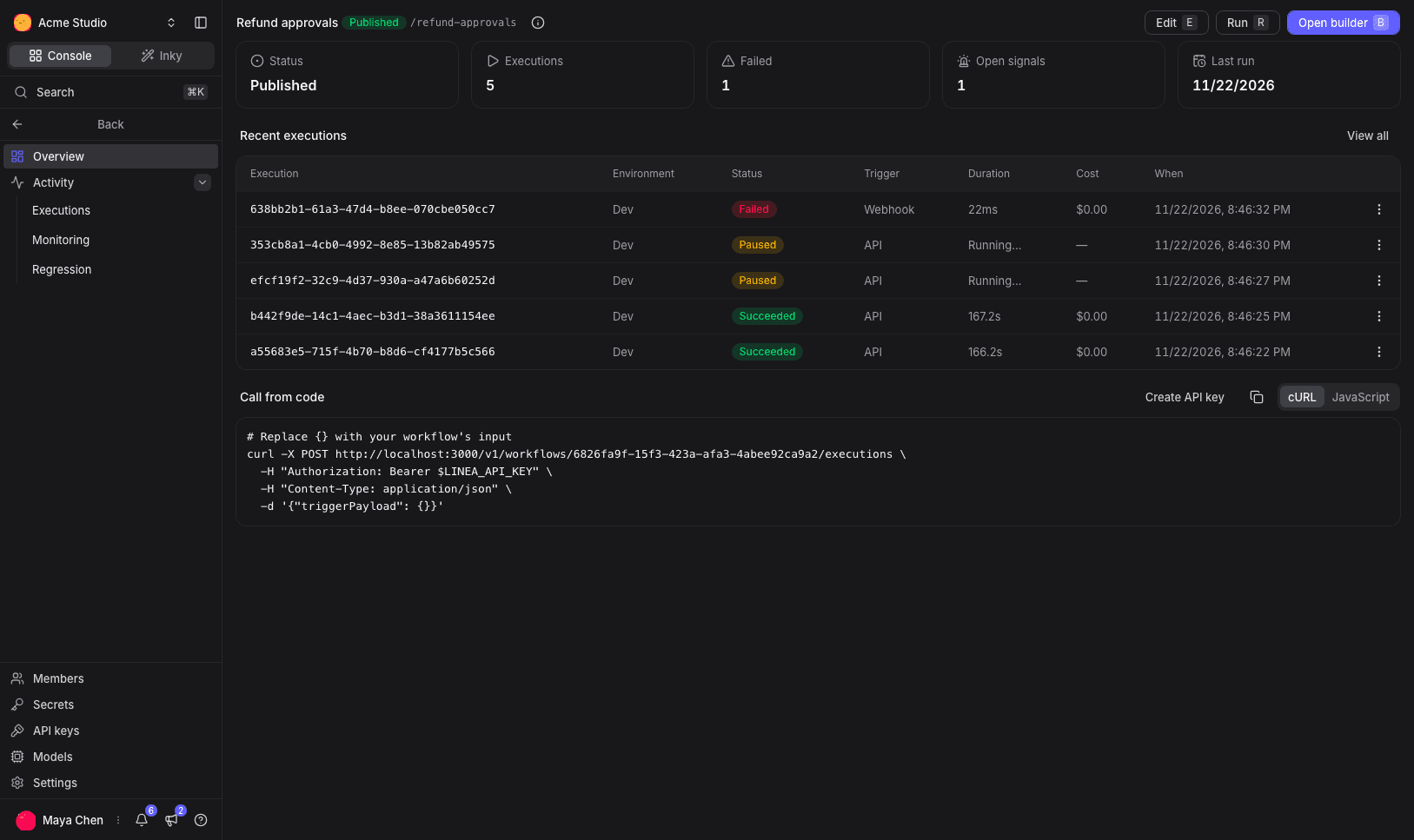
Traces you can read. Every step is stored with its node id, attempt, input and output, error and usage, along with cost and token counters on the execution. An execution also records whether any step ran on a model with no known price, so unknown pricing is flagged rather than silently counted as free.
Bounds by default. A graph run stops after 30 minutes, a node attempt after 60 seconds, and an execution after 1,000,000 tokens. Agent loops are capped at 25 iterations and a 30 minute work budget.
Memory on the host. Keyed facts with an expiry, scoped to the environment and the end user, so the next run reads what the last one learned (memory).
How to choose
Here is a rough rule, without pretending there is a score. Use Zapier when the agent is one step in a business automation, the actions are low risk, and you want zero infrastructure. Use n8n when you want a visual workflow tool with a broad integration list, self-hosting and per-tool human review, and the runs are short. Use an agent runtime like Linea when the agent is part of your product, runs take real time, it writes to systems where a duplicate or a stale approval is a real problem, and you need to replay a failed step and ship a fix without guessing.
These are not exclusive. A team can keep n8n or Zapier for internal glue and run the customer-facing agent on a runtime.
What Linea does not do yet
To be fair about the trade-off: Linea's connector list is much shorter than n8n's or Zapier's. Today it ships a GitHub connector, a Google connector for Gmail and Calendar, and outbound HTTP. Arbitrary MCP tools, sandboxed code execution, and owned knowledge-base and RAG infrastructure are not shipped. Linea is also pre-1.0, so interfaces may change. If you need a hundred integrations this week, a workflow tool will get you there faster.
Try it
If the questions above sound like your week, start with the getting started guide: draw a graph, publish a version and run it. The code is on GitHub, and the architecture page explains how the host, workers and checkpoints fit together.